The Ultimate
Gaming Audio Setup.
Sub-10ms latency, positional precision, and a chest-thump that finds you in every firefight. A 5.1 build with no Atmos, no compromises on the things that matter.
As an Amazon Associate, Worldray earns from qualifying purchases.
Who this is for
This is the build for a single-room gaming setup where the screen and the chair are the centre of gravity. Living-room corner, bedroom, dedicated gaming office — all fine. A sofa with three seats works too, if you accept that the front-left or front-right viewer will get a slightly compromised soundstage; the speakers in this build are voiced for the centre seat, like every speaker pair ever made.
It’s not the build for a serious dedicated home cinema. There’s no centre channel, no Atmos height speakers, and the surrounds are a deliberate step below the fronts. You’re paying for things that matter to gaming — fast, clean low end; off-axis dialogue clarity; a receiver that does VRR/ALLM/4K120 without wrinkles — and not paying for a full 7.1.4 ceiling install you won’t get the benefit of unless you’re sitting in a treated room.
If you’re an aspiring home cinema enthusiast who plays games as a side activity, scroll through to Cinema Room Done Right instead. This page is for people who play 30+ hours a week.
The build
Five components. Five jobs. Each one earns its place against cheaper and pricier alternatives in the same role.
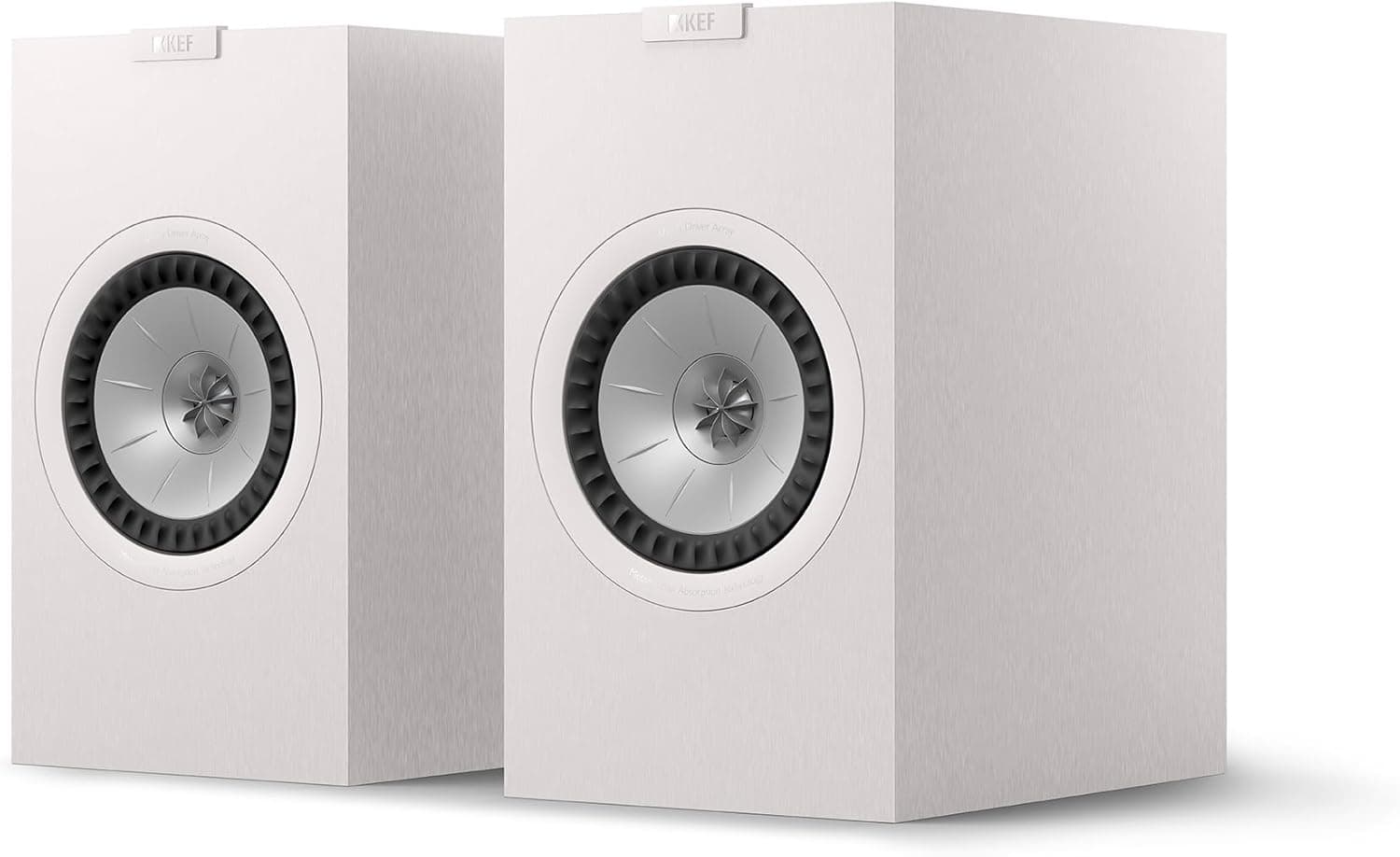
KEF Q3 Meta
The Q3 Meta uses KEF’s Uni-Q point-source driver, where the tweeter sits at the acoustic centre of the mid-bass cone. For gaming this matters more than it does for any other use case. Every spatial cue — footsteps, weapon report direction, off-screen dialogue — collapses to a single, stable point in space rather than smearing between a separate tweeter and woofer.
The MAT damping cleans up the back-wave so the imaging stays locked even off-axis, when you’re not exactly in the chair. £649 a pair gets you the same trick as the LS50 Meta in a more forgiving cabinet.
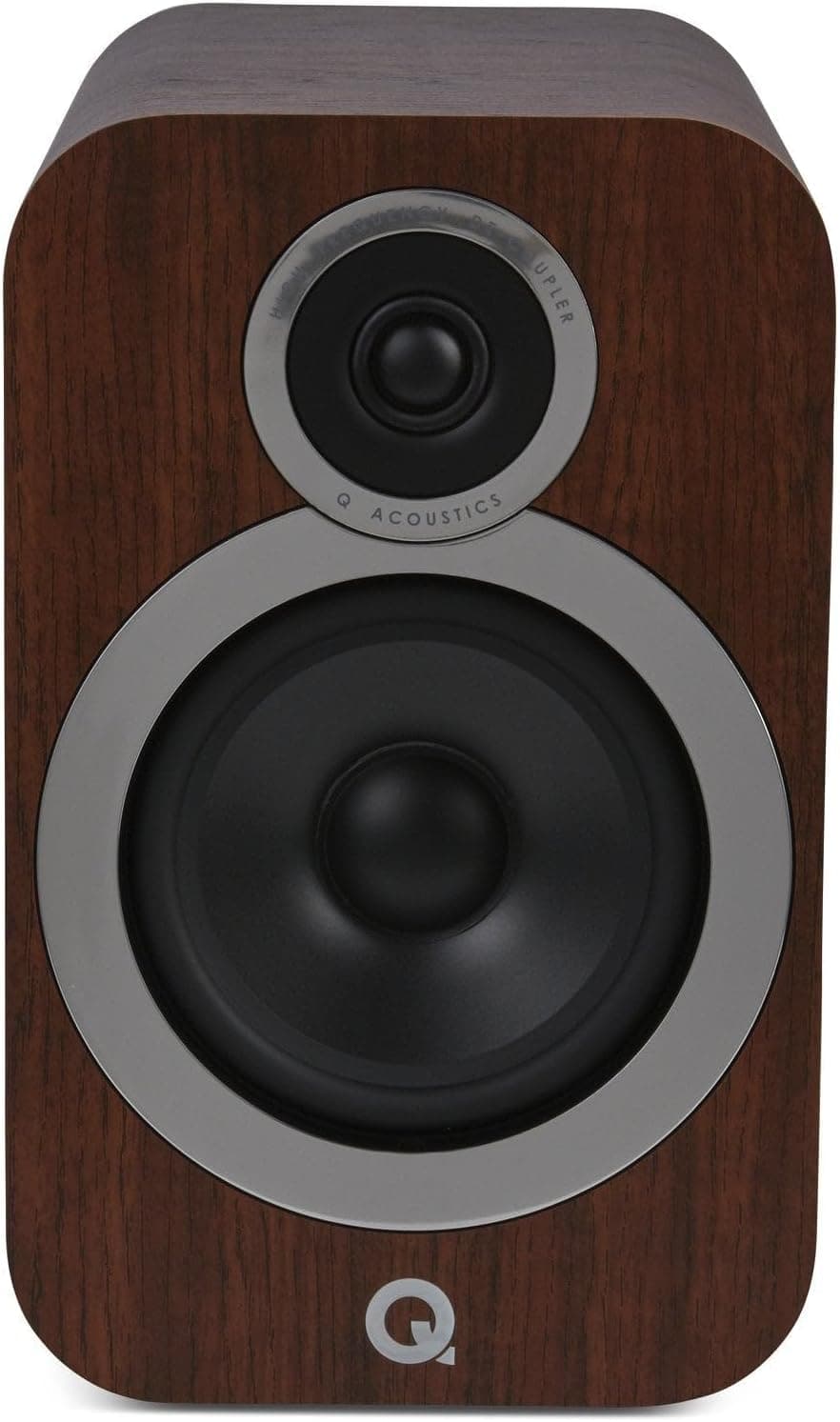
Q Acoustics 3030i
Surrounds get less attention than fronts and most people massively over-spend on them. The 3030i has the cabinet bracing and dispersion to handle surround duty without colouration, which is exactly what surrounds need: be invisible, place the effect, get out of the way.
88dB sensitivity into a friendly 6Ω load means a mid-range AVR drives them properly without thinking about it. They double as a credible second pair of fronts if you ever want to run them as a stereo pair in a different room.
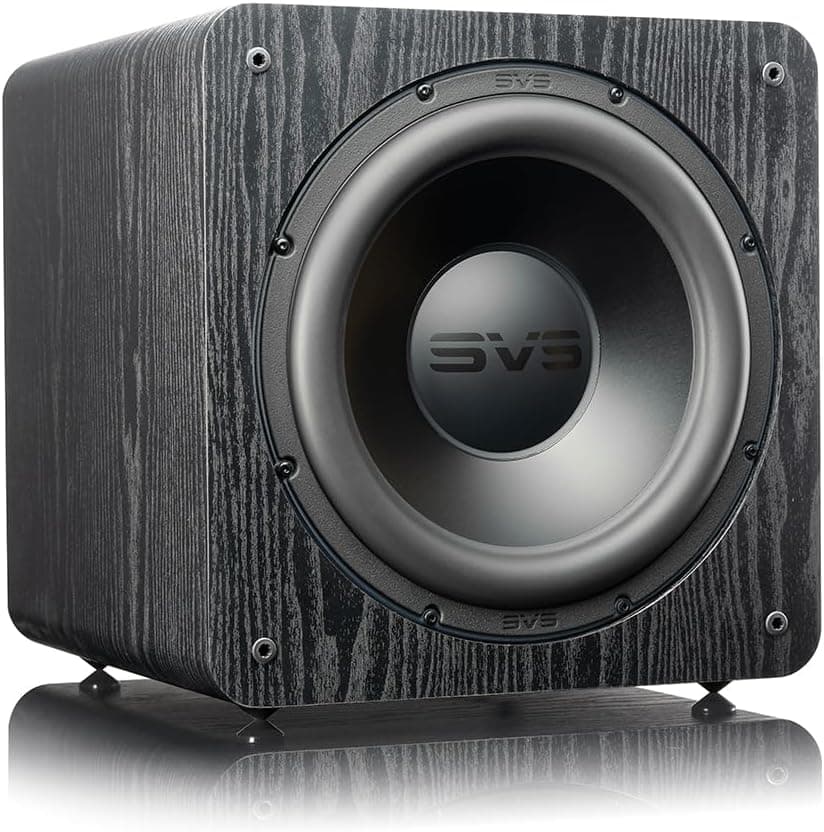
SVS SB-2000 Pro
Sealed sub, 12-inch driver, 550W RMS, app-controllable parametric EQ. Sealed matters for gaming. A ported sub gives more SPL per pound but the trade-off is group delay — the sub starts and stops slower.
For gunfire transients, footsteps, and the quick-onset/quick-decay impacts in gaming, you want the sealed cabinet’s tighter time domain even when the spec sheet looks less impressive on paper. The SVS app lets you cut the inevitable room mode without leaning on the AVR’s correction.
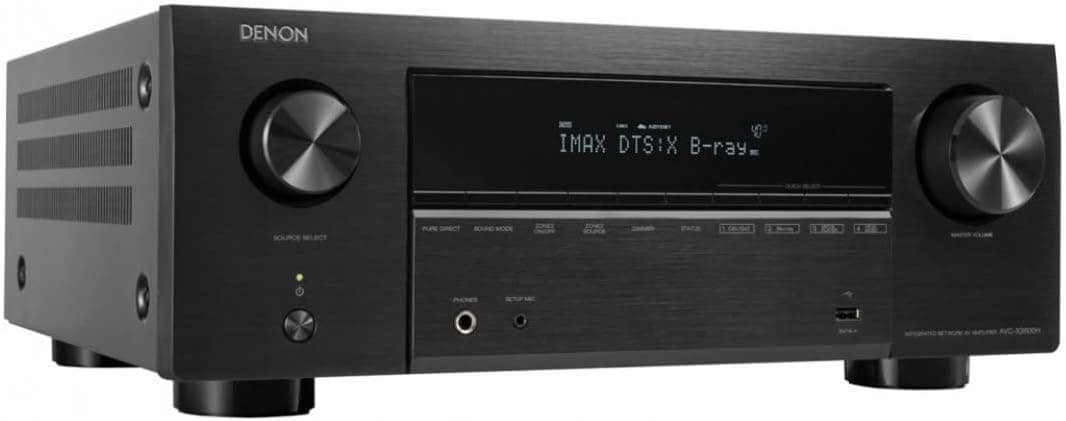
Denon AVC-X3800H
9.4 channels you don’t need yet, Dirac Live readiness you do. The AVR is the gaming setup’s nervous system: it has to do 4K120, VRR, ALLM, and HDMI 2.1 passthrough on every input, and the X3800H does.
Dirac Live (sold separately as an add-on licence) is a meaningful step up over Audyssey for the hostile acoustics most gaming rooms have. The 9.4-channel topology buys you the option to add Atmos heights later without a receiver swap.
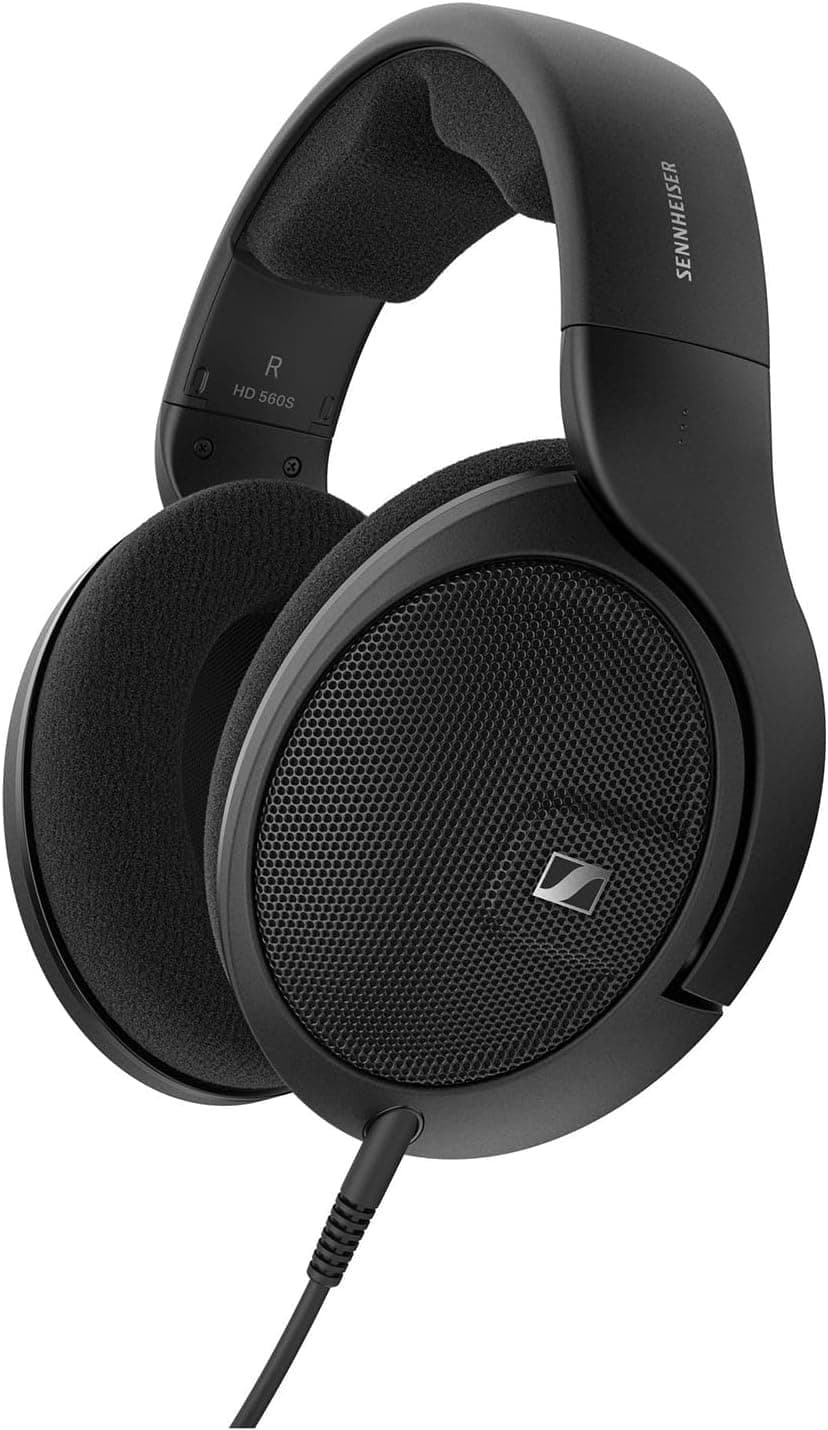
Sennheiser HD 560S
Open-back, neutral, mid-impedance, accurate. The 560S has the flattest response of any sub-£200 open-back headphone and the soundstage to support genuine binaural cues — important when you’re playing competitively and need to hear lateral and rear positioning.
£179 and they outperform every closed-back “gaming headset” twice the price. They want an amp on a serious source but plug straight into a controller’s 3.5mm or motherboard headphone-out and still do most of the job.
No centre, no cables, no panels.
Centre channel. Worldray doesn’t review centre channels yet. This build runs phantom centre — see “Why these picks” below for the reasoning.
Speaker cable. Worldray doesn’t review cabling. 12 AWG oxygen-free copper is the spec to look for — Amazon UK search. Subwoofer cable is RCA, single screened core — Amazon UK search.
Room treatment. Two thick rugs, heavy curtains, and a bookshelf on the first reflection wall solve 80% of acoustic problems for free. Dedicated panels come later.
Why these picks specifically
Three of the picks are obvious in the abstract; the AVR and the surround choice are not.
I went Denon X3800H over the Marantz Cinema 70s — same money in the budget — because for gaming the X3800H gives you Dirac Live readiness and 105W per channel into 8Ω, where the slimline Cinema 70s tops out at 50W and doesn’t take Dirac. The Marantz wins on character through the front pair when you put it next to a pair of LS50 Meta and a vinyl source; for a gaming-first system it doesn’t earn the price differential. If you don’t care about Dirac and you do care about smaller chassis depth, the Cinema 70s is fine — but you’re paying Marantz hi-fi tax for amplifier headroom you’ll use 20% of the time.
The KEF Q3 Meta over the LS50 Meta is a deliberate down-spec. The LS50 Meta is the better speaker by every measurable metric. But for gaming, you’d be paying £875 more per pair (£1,524 vs. £649) for resolution your AVR’s room correction will probably blunt before you hear it. The Q3 Meta gives you 90% of the imaging trick at 43% of the price. The remaining £875 goes into the X3800H and pays for itself in calibration headroom.
The 3030i for surrounds, not a matching KEF Q-series, is partly catalogue (we don’t review the Q-series surround/centre at the moment) and partly intentional. KEF and KEF makes for a very pretty system that will image identically across all five channels — which is great for film mixing. For gaming, where surrounds are hit with synthetic ambient noise and effect placements, you need surrounds that disappear, which the 3030i does for less money.
There’s no centre channel in this build. That’s the contentious one. Most home cinema purists will tell you the centre is non-negotiable. For single-seat gaming with the listening position locked to the centre line of the front pair, a phantom centre using a properly imaging Uni-Q pair is genuinely better than a budget centre channel in a different cabinet. The Q3 Meta’s point-source driver locks the phantom dead between the speakers as long as you’re in the seat. Two-seat gaming compromises this; if your sofa has three seats, add a centre and we’ll review them properly soon.
The room
Speaker placement
Front pair on stands, tweeters at ear height when seated. Slight toe-in — about 10° — so the on-axis response converges roughly a foot behind your head, not at your face. This widens the sweet spot. Get them at least 25cm off the rear wall; the Q3 Meta is rear-ported and bass thickens up unpleasantly when it’s wedged against drywall.
Listening distance
Equilateral triangle. If your speakers are 2.4m apart, sit 2.4m from the front baffle. Beyond about 3m the Q3 Meta starts running out of energy and you’ll feel like the system is undersized; under 1.8m and the imaging gets edgy because you’re hearing too much direct sound versus reflected. Most desk-and-chair gaming setups are at 1.5–2m, which suits these speakers perfectly.
Surrounds
Mounted at ear height when seated, behind the listening position by about 30°. This is the ITU 5.1 reference angle. If you can’t get them behind, side-fire placement — directly to the left and right of the chair — works better than mounting them in front. They’re surrounds, not a second pair of fronts.
Sub placement
Crawl test: put the sub in the listening seat, play bass-heavy content, walk the room corners, find the spot where the bass is strongest and tightest. Move the sub there. This works because room modes are reciprocal — wherever bass is loud at the listening position, that’s where the sub will excite the room least. Use the SVS app to flatten any remaining peak with parametric EQ afterwards.
Calibration
Run Audyssey first as the baseline. If you’re going to upgrade to Dirac Live, do it after you’ve lived with Audyssey for a couple of weeks — you’ll know what the room is doing wrong, and Dirac’s manual targeting curve will make sense. For pure gaming, the default Dirac curve with a slight 1–2dB downtilt above 1kHz is what most people end up at.
Cabling
12 AWG (2.5mm²) speaker cable for the fronts; 14 AWG (1.5mm²) is fine for the surrounds — runs are short, power delivery less critical. Any decent oxygen-free copper from Amazon UK will do; cabling isn’t where the audible difference lives at this level.
What to upgrade first
If you have another £500–£800 to spend after the initial build settles, upgrade the AVR’s calibration before anything else. That means buying the Dirac Live full-bandwidth licence (about £350) and a calibration mic if your AVR doesn’t ship with one capable of multi-position measurements.
Dirac in a real gaming room — drywall, hard floor, screens that reflect, a chair full of soft fabric directly behind your head — is the single biggest improvement you can make for under £500. It eclipses speaker upgrades, sub upgrades, and headphone upgrades by a margin most people don’t expect until they’ve heard it. If you’ve already done Dirac, the next step is a second SVS sub: stereo subs are the only legitimate reason to think the room doesn’t sound right yet.
What about the obvious alternatives
What about a soundbar?
A good soundbar — Sonos Arc, Sennheiser Ambeo Mini — is decent for casual use but loses to this build on three things competitive gaming actually cares about. Latency: soundbars introduce processing delay that traditional AVRs don’t. Positional accuracy: virtual surround and beamforming work for film soundstage but break down on the rapid-fire spatial cues in gaming. Headphone output: most soundbars can’t drive a proper 120Ω+ open-back. If you’re choosing between a £900 soundbar and this £3,776 build, you have already decided you care; the soundbar will frustrate you within a month.
Why not the cheaper Denon AVR-X1800H?
Because it doesn’t take Dirac, it caps at 7.2 channels with no Atmos height upgrade path, and its HDMI 2.1 implementation has known compatibility quirks with PS5/Xbox VRR mode that Denon haven’t fully resolved across firmware revisions. Saving £1,100 on the receiver is real money — but you’ll spend most of it in two years upgrading. The X3800H is the “buy once” point in Denon’s mid-range.
Can I run this off a PC instead of an AVR?
You can run the headphones and a stereo pair off a USB DAC/amp into the front L/R, but you lose the surround channels, the sub crossover management, and the Dirac path. The whole reason this build is shaped like it is — discrete AVR + 5.1 + headphones — is that it does both modes (speakers when you want presence, headphones when you want privacy or competitive precision) without compromise. A pure-PC build is fine if you’re sure you’ll never want speaker-mode gaming.
Want to spec a similar build with different gear?
Try the Worldray Configurator with the gaming use-case pre-selected — swap speakers, change subs, see compatibility warnings as you go.