Cinema Room
Done Right.
7.1.4 Atmos, calibrated to within a dB. Treated walls, hidden cabling, and a screen that disappears. The build that justifies every pound of its sticker.
As an Amazon Associate, Worldray earns from qualifying purchases.
Who this is for
This is the build for a dedicated, light-controlled room where film is the primary use. Basement, attic conversion, garage build-out, or a properly drawn living room you’ve committed to — anywhere with the geometry and the discipline to put a calibrated system in. If you’re still choosing between the dining table and a cinema room, this isn’t the post for you yet.
The reader for this build watches at least three films a week, likes the lights all the way down, and treats the seating position like a recording studio’s mix chair — fixed, calibrated, optimised. Gaming on this rig is fine, but the priorities here are bit-perfect 4K HDR film playback, lossless multi-channel audio, and a soundstage that lifts off the screen plane.
It’s not the build for casual film viewing in a living room shared with daylight, kids, and a TV cabinet that can’t be moved. For that, the smaller scope of an Epson UST and a Sonos Beam will outperform half-installed cinema gear every time.
The build
Five reviewed picks plus three deliberate gaps — centre, Atmos heights, treatment. The reviewed picks total £9,916; the gaps add roughly £1,300–£1,800 depending on how seriously you take the install. All-in for a properly capable 7.1.4 cinema room: around £11,000–£11,500.
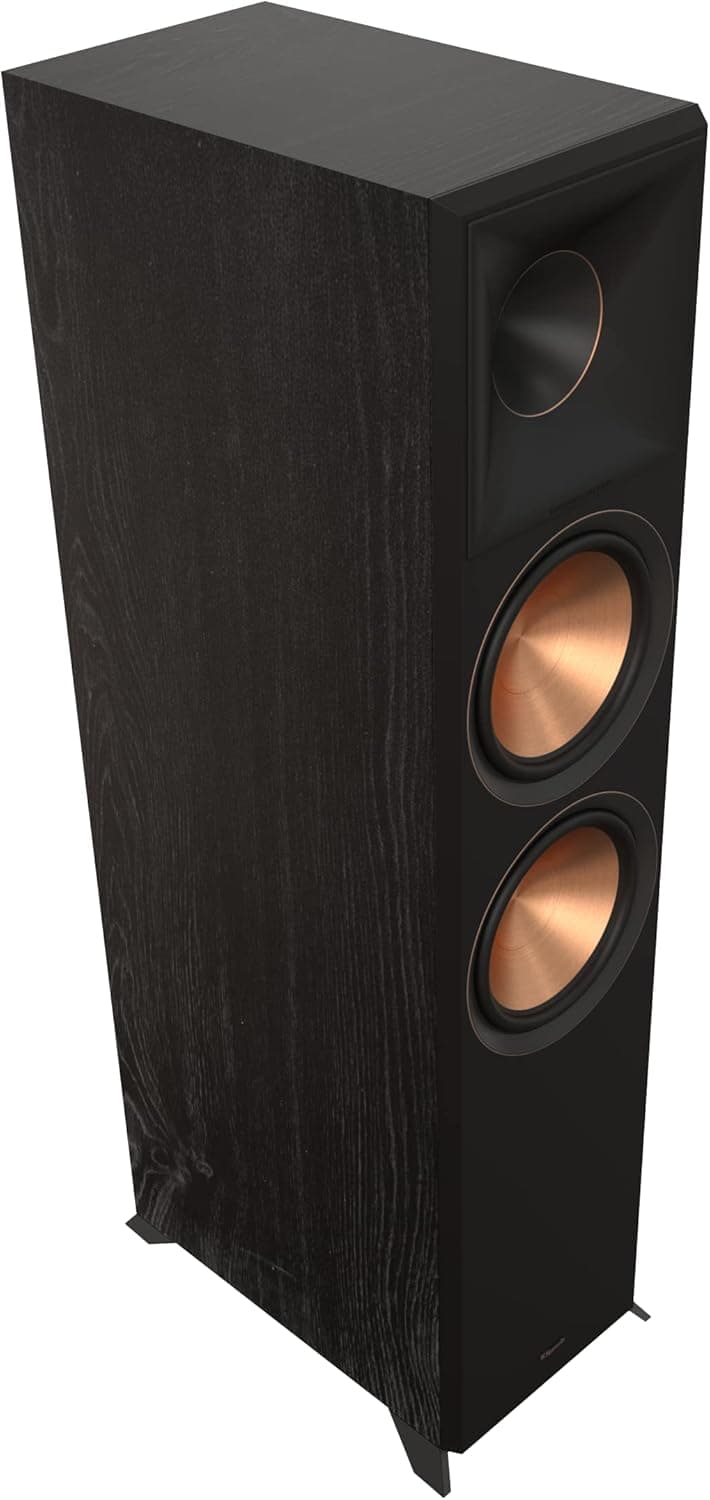
Klipsch RP-8000F II
Cinema is where horn-loaded dynamic capacity earns its place. The RP-8000F II runs 98dB into a friendly load — class-leading among floorstanders at this price — which means the AVR doesn’t have to work hard to hit reference level.
The Tractrix horn projects dialogue with a clarity that cuts through busy mixes. V-shape voicing wouldn’t suit dedicated stereo audiophile listening, but for film — where the mix engineer expects the playback chain to deliver impact — it does exactly that.
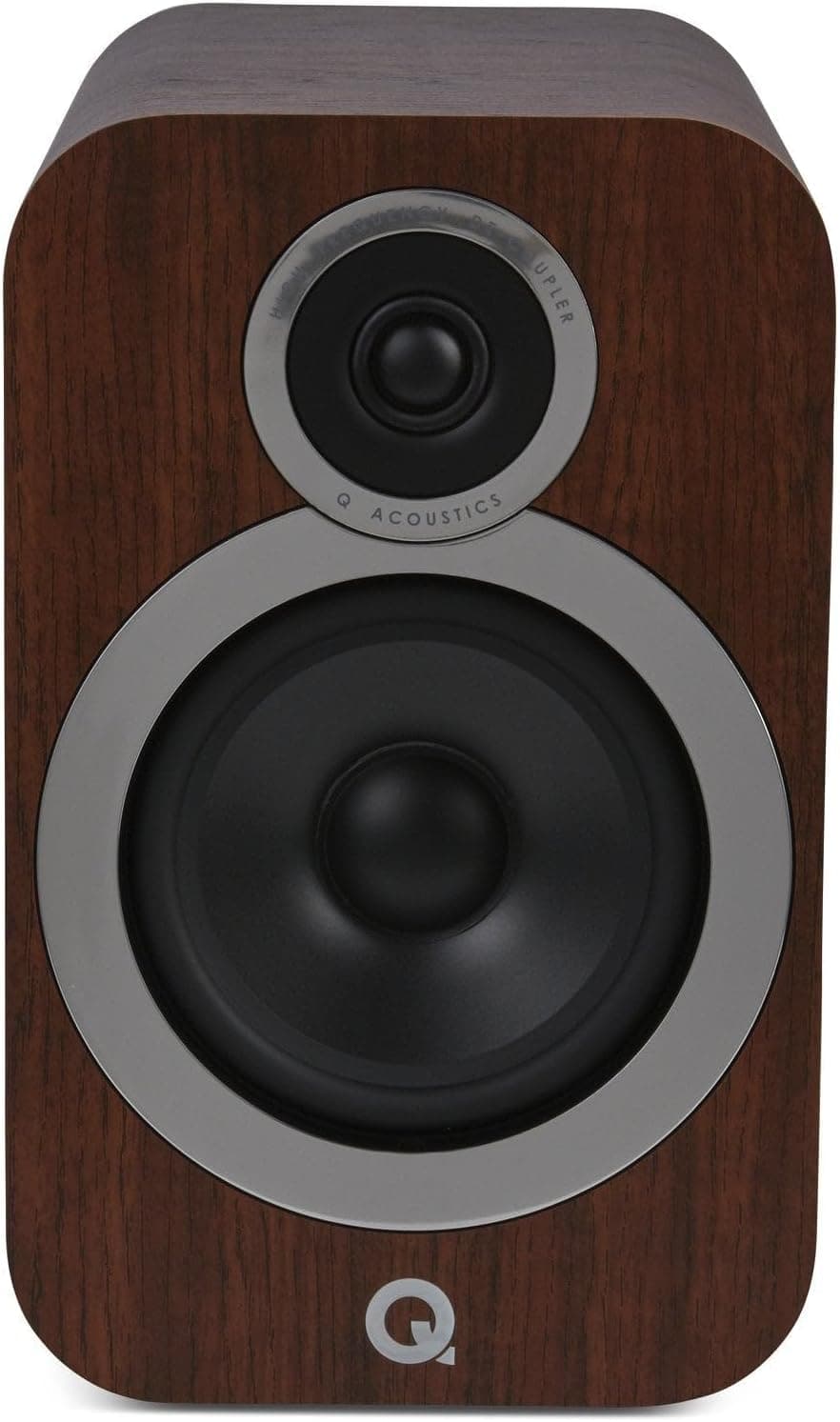
Q Acoustics 3030i
Four 3030i for a 7.1 surround layout — two side-fire, two rear. Surrounds in a cinema room get more sustained workload than fronts (ambient effects, score wash) and the 3030i’s properly braced cabinet handles it without resonance.
They disappear sonically the way good surrounds should, leaving placement information to the mix rather than the speaker character. £225 per channel for surround duty is the right zone — spending more on matched fronts/surrounds is a luxury, not a requirement.
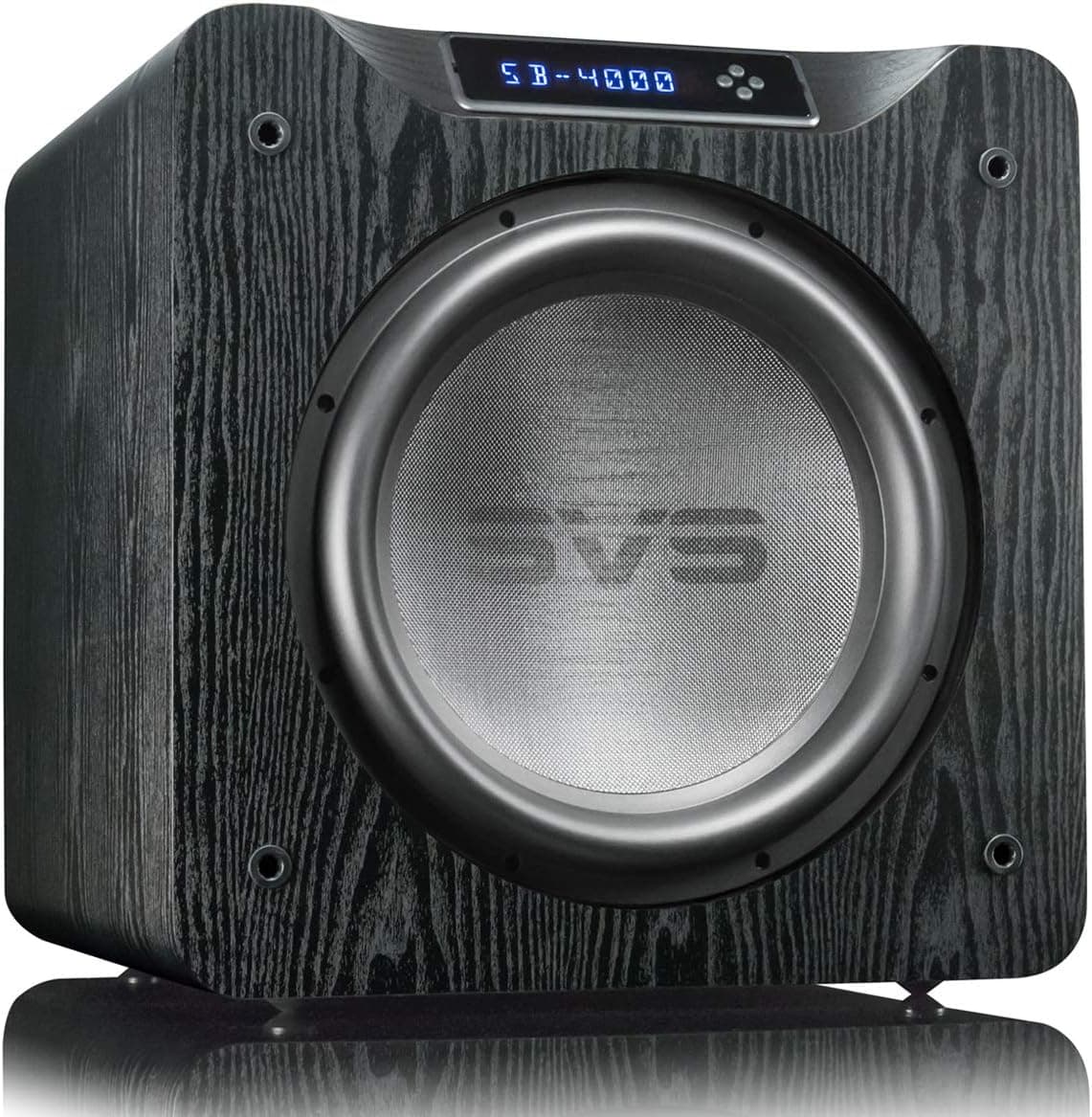
SVS SB-4000
13.5-inch driver, 1,200W RMS, 800W amplifier, sealed cabinet, app-controllable parametric EQ. The SB-4000 is the cinema sub the rest of the SVS range steps down from.
For a properly sized cinema room you want the headroom. A 12-inch sub will reach reference but with audible compression on the demand-of-the-decade scenes. Sealed cabinet means tighter than a comparable ported sub — your dialogue and effects keep their time-alignment when hits hard.
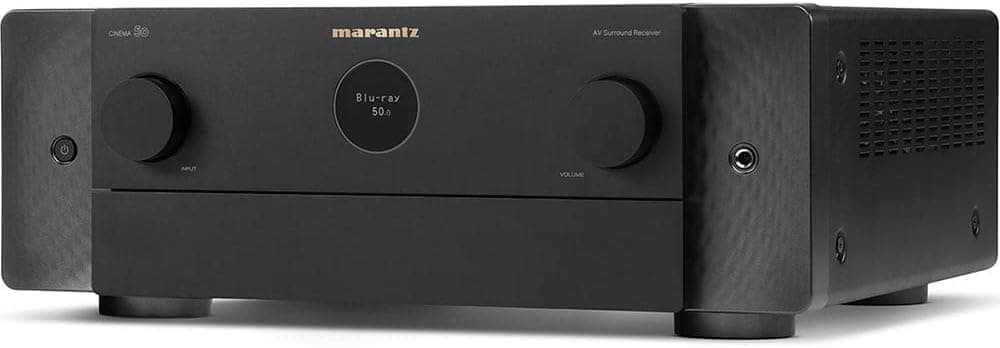
Marantz Cinema 50
9.4-channel amplification, 11.4-channel processing, ready, HDMI 2.1 with 8K passthrough on all inputs, full HDR10+/Dolby Vision. For 7.1.4 this means 5.1.4 native or 7.1.4 with an external 2-channel power amp for the rear surrounds.
The Marantz HDAM analog stage gives the front pair a warmer, more “hi-fi” character than the Denon equivalents at the same money — which matters when the system does music duty alongside film. 110W per channel into 8Ω, 4Ω stable.
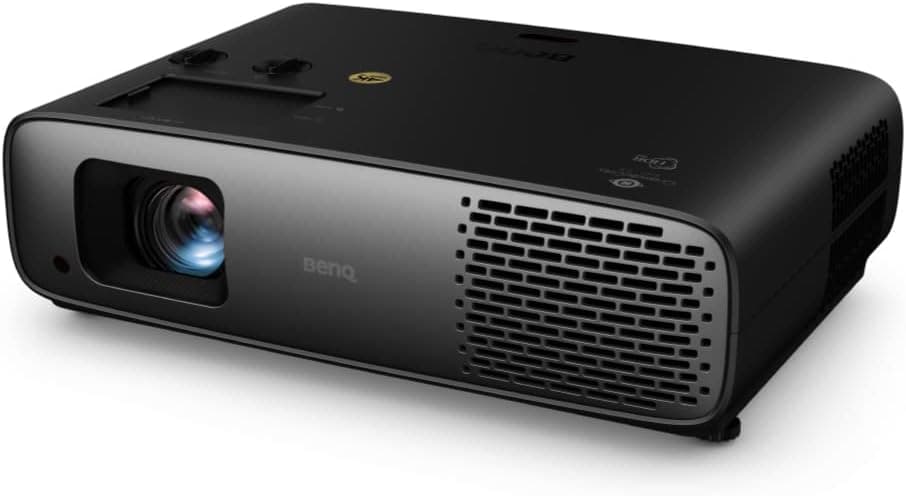
BenQ W4000i
4K UHD via DLP pixel-shift, 4-channel LED light source rated for 200,000 hours (no lamp replacement, ever), 100% DCI-P3 colour coverage, 600,000:1 native contrast with dynamic iris. Properly cinema-grade HDR without professional calibration.
16ms input lag at 4K/60 if the room ever does duty as a gaming room. The trade-off vs the JVC DLA-NP5 above it is native vs pixel-shifted 4K — at typical viewing distances the difference is minor; at £2k less, the choice is easy.
Centre, heights, cabling, treatment.
Centre channel. Worldray doesn’t review centres yet. Match the Klipsch front pair with a Klipsch RP-504C or RP-500C-class centre — Amazon UK search. Allow ~£500.
Atmos heights × 4. In-ceiling speakers aren’t covered yet either. For 6.5″ in-ceiling drivers in a sealed back-can, Q Acoustics Qi65CW or KEF Ci200RR-THX are sensible starting points — Amazon UK search. Allow ~£800 for a quad set with quality bracketing.
Cabling. 12 AWG OFC for fronts and centre, 14 AWG for surrounds and heights, screened RCA for the sub — Amazon UK search. Allow ~£100.
Acoustic treatment. Two corner bass traps and four first-reflection panels make a measurable difference in any real room. GIK, Vicoustic, or DIY rockwool wrapped in fabric. Allow ~£300 entry-level, £700+ for properly designed.
Why these picks specifically
Three of the picks need defending: the AVR, the Klipsch fronts, and — above all — the projector.
The Marantz Cinema 50 over the Denon AVC-X3800H costs another £1,000 for the same channel count and the same Dirac path. That money buys you a more refined HDAM analog stage, a copper-plated chassis that genuinely resists EMI, and 4Ω stability rated for serious main speakers. The HDAM character isn’t decisive on a film-only system — film mixes are mastered for accuracy, not warmth — but the Cinema 50 tracks louder with less protection-circuit nervousness when the room hits reference. If a system does double duty for stereo music alongside film, the Marantz earns the upgrade. If it doesn’t, the X3800H is a perfectly defensible save.
The Klipsch RP-8000F II as cinema fronts, instead of KEF R3 Meta or KEF R7 Meta, is the contentious call. KEF’s gives better off-axis dispersion — technically correct for a multi-seat cinema. But two practical points push me toward Klipsch. First, sensitivity: R3 Meta is 87dB into a 4Ω load that dips to 3.2Ω; the AVR has to work properly hard to drive it at theatre level. RP-8000F II is 98dB / 8Ω — eleven decibels of sensitivity advantage, which is roughly a doubling of perceived loudness for a given amp output. Second, voicing: cinema mixes are not stereo masters. The Klipsch V-shape — boosted lower mids, cooled upper mids, lifted treble — happens to map almost perfectly onto how cinema dialogue and effects are mixed. R3 Meta is the more “correct” speaker; RP-8000F II is the more “right” cinema speaker.
The BenQ W4000i over the JVC DLA-NP5 is straightforward economics. The JVC at £4,999 gives you native 4K D-ILA, true black levels, and a dynamic iris that’s actually credible in dark scenes. It is the better projector, end of. But it costs £2,215 more, and at typical 100–120-inch screen sizes from 3–4m viewing distance, the pixel-shift / native difference is genuinely hard to see. Spend the £2k saving on a proper screen, dual subs, and acoustic panels — all of which contribute more to the perceived experience than projector pedigree.
The room
Speaker placement
Fronts go either side of the screen, toed-in 12–15° toward the main listening position. If you’re using a perforated acoustically-transparent screen with an LCR shelf behind it, mount the fronts level with the screen centre line; otherwise put the tweeters at seated ear height (around 1.1m from the floor). Klipsch is rear-ported — keep them 30–40cm clear of the rear wall.
Centre channel
Behind a perforated screen if possible — that puts the dialogue source exactly where the actor’s mouth is. If you’re using a non-AT screen, the centre goes either directly above or directly below the screen, angled toward seated head height. Above is preferred (less floor reflection).
Surrounds and heights
Side surrounds: ear height when seated, 90–110° from the listening centre line — directly to the side of the MLP, not behind. Rear surrounds: behind the seating, 135–150° from the centre line, ear height again. Atmos heights: front pair 30–45° forward of the MLP, rear pair 110–125° behind, mounted in the ceiling and angled toward the seated head. 6.5″ drivers in a sealed back-can — the sealed enclosure is what stops attic-cavity coupling.
Sub placement and dual subs
Single-sub: do the crawl test. Sub in the listening seat, walk corners playing 30Hz tone, find the spot where it’s loudest and tightest, put the sub there. Single-sub will always have a residual . The upgrade path — and the textbook answer for a Cinema-Done-Right room — is dual subs at the mid-points of opposite walls. This cancels the strongest length-axis modes by 6–10dB and smooths bass response across all seats simultaneously.
Calibration
first as a baseline, then pay for the Dirac Live full-bandwidth licence (~£350) and re-calibrate. Dirac on the Cinema 50 will deliver measurably flatter bass response and tighter time alignment than Audyssey can. Run measurements at the MLP plus ±0.5m offsets to capture sweet-spot variance. Save the Dirac filter, A/B against Audyssey for a week, then commit.
Lighting and screen
Bias lighting behind the screen at 6500K calibrated to ~10% of peak white luminance — easier on the eyes for long sessions and improves perceived black level. Black non-reflective surfaces around the screen (matt black paint, velvet panels at the edges). Black ceiling above the screen if budget allows.
Cabling
12 AWG OFC speaker cable for LCR; 14 AWG for surrounds and heights. Pre-wire the heights inside the ceiling joists during construction if you can — running them after-the-fact is the single most regretted shortcut in cinema builds.
What to upgrade first
A second SVS SB-4000. Dual subs at opposite-wall mid-points are the upgrade with the largest measurable improvement in a cinema room — they cancel the dominant length-axis mode by 6–10dB across all seats, which delivers smoother bass at the MLP and, more importantly, makes off-MLP seats listenable. Most cinema rooms peak at one bass-heavy seat and one bass-shy seat; dual subs solve this. £1,999 for the upgrade.
Second priority is acoustic treatment, third is upgrading the projector to the JVC DLA-NP5 if blacks are the visible issue in your room. Upgrading the AVR to Cinema 30 is the lowest-priority upgrade — Cinema 50 has more headroom than 95% of rooms will ever exploit.
What about the obvious alternatives
Why this Marantz over the Denon flagship?
The Denon AVC-X4800H at £2,499 is a credible alternative — 9.4-amplified, Dirac-ready, slightly stronger amp section per channel than the Cinema 50, Audyssey XT32 with full mobile-app calibration. It’s the more film-accurate AVR. The Marantz wins on character through the front pair (HDAM analog stage), build quality (copper-plated chassis), and a slightly more refined preamp section. If your system does any music duty, Cinema 50. If it’s pure film and you’d rather pocket the £100 difference, X4800H is the better choice.
What about LCR matched fronts vs separate centre?
A matched LCR — left, centre, right all from the same manufacturer’s range — gives you tonal continuity across pans. Actor moves left-to-right and the timbre stays identical. That’s audibly correct. The trade-off is cost (matched centres from premium brands run £600–1,500) and aesthetics, since matched centres don’t always fit under a screen. For Cinema Room Done Right, the matched centre is the right answer; that’s why Klipsch is the front choice — RP-504C as the matching centre is a known-good pair. Avoid mixing brands in the LCR if you can possibly help it; the timbral mismatch is the single most audibly distracting aspect of an otherwise good system.
What about a UST projector instead of long-throw?
A UST projector — BenQ V7050i, Epson LS800B — saves you the ceiling install and the long throw distance. For a multi-purpose living room they’re the right answer. For a dedicated dark-room cinema where black level matters, long-throw wins. The W4000i in a fully-controlled room delivers contrast a UST cannot match in any room with any ambient light. Choose UST if you cannot dedicate a room; choose long-throw if you can.
Want to spec a similar build with different gear?
Try the Worldray Configurator with the movies use-case pre-selected — swap fronts, change projectors, see compatibility warnings as you go.