The Audiophile
Listening Room.
A pair of speakers, a chair, and the truth. Two channels, properly resolved — the build at the point where audiophile economics stop being linear.
As an Amazon Associate, Worldray earns from qualifying purchases.
Who this is for
This is the build for a listener who has accepted that two channels is the right number of channels. No surrounds, no centre, no Atmos heights. A pair of speakers, an amplifier, a source, and the geometry to put them in the right place. The reader for this build sits in one chair, listens with intent, and considers a properly-recorded album an event in itself.
It’s a stereo system, deliberately. Pairing it with film duty is technically possible — the integrated amp can drive a TV’s audio output via a DAC and the result will be a credible 2.0 cinema soundtrack — but if film is a primary use case, you want a different build (see Cinema Room Done Right). Here the priority is timbral accuracy, image stability, and the kind of low-level resolution that survives at quiet listening levels.
It’s also not the build for casual background listening. The R7 Meta repays attention. They’re not analytical-cold — they’re musical and warm-leaning — but they reward sitting down and letting an album finish.
A note on “audiophile” as a category. It’s a moving target. There is no point at which you stop being able to spend more money for measurable improvement; the question is where the improvement-per-pound curve flattens. This build sits at that flattening point — beyond it, you pay exponentially more for incrementally less.
The build
Two reviewed picks plus a deliberate gap in stereo electronics Worldray hasn’t yet covered in depth. Reviewed picks total £5,198. The amp + DAC/streamer chain costs another ~£2,350. All-in for a properly resolving stereo system: around £7,500 — top end of the audiophile budget tier.
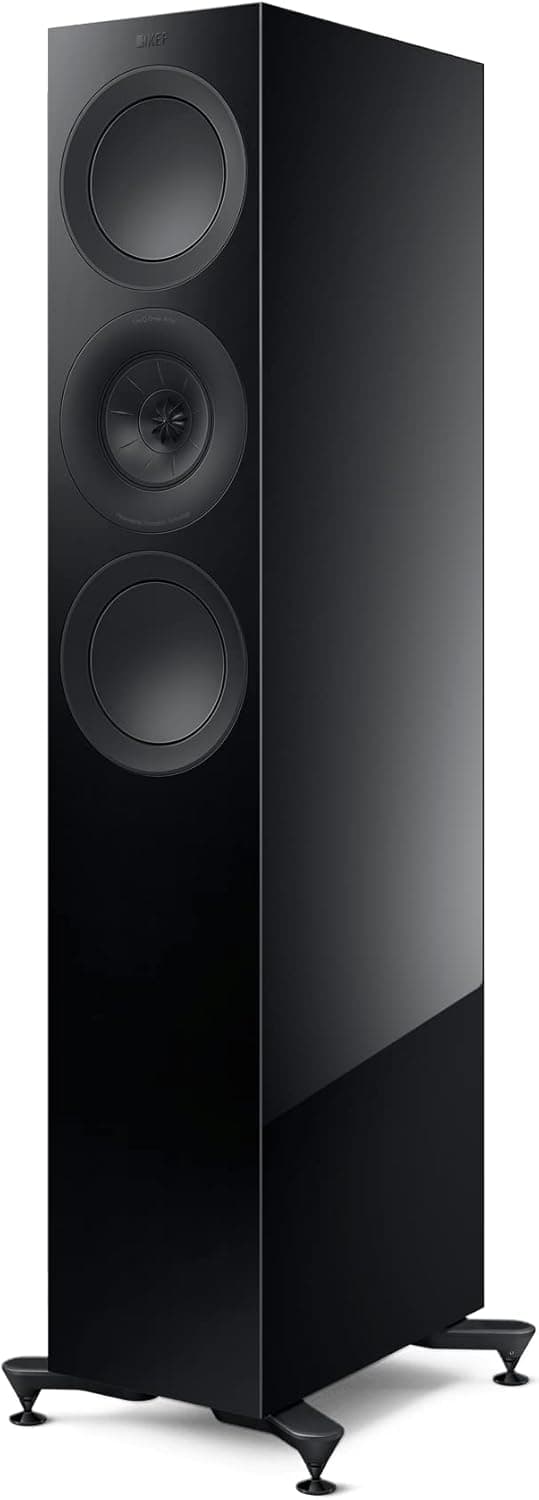
KEF R7 Meta
The R7 Meta sits at the top of KEF’s R series — the floorstander you specify when you want LS50 Meta DNA in a full-range cabinet without paying Reference money. The Uni-Q point-source array gives you imaging stability LS50 Meta-on-stands listeners don’t realise they’re missing.
MAT damping clears the upper mids of cabinet artefacts. Bass to 32Hz in-room means no sub strictly necessary for music, though one helps. 4Ω, 87dB sensitivity — these want at least 100W of clean Class A/B per channel.
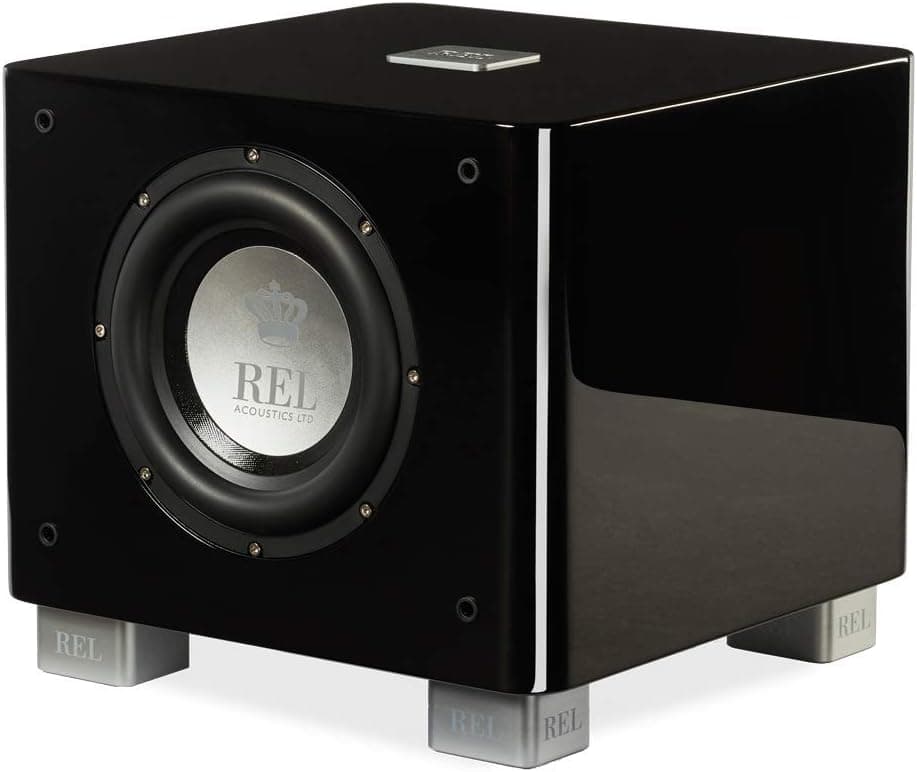
REL T/7x
A REL is the audiophile sub. The T/7x has the high-level Neutrik connector that lets you take signal directly off the integrated amp’s speaker terminals — meaning the sub gets the same crossover-free, character-preserved signal the speakers do, instead of a low-passed version through an LFE bus.
Result: a sub that integrates as part of the stereo signal path, not a tagged-on cinema afterthought. Sealed cabinet, fast and tuneful. Add it for the 20–32Hz octave the R7 Meta can’t quite cover.
Integrated amp, DAC/streamer, cabling.
Worldray hasn’t reviewed two-channel integrated amplifiers, DACs, or streamers in depth yet — the catalogue is currently AV-receiver-led. The recommendations below are starting points, not fully reviewed picks.
Hegel H120
75W into 8Ω, fully balanced, built-in DAC, AirPlay, Roon Ready. Current capability for the R7 Meta’s 4Ω load. Neutral-with-warmth voicing, known good match for KEF MAT speakers. Search Amazon UK.
Bluesound Node 2024
Roon Ready, Tidal/Qobuz/Spotify Connect/AirPlay, BluOS multi-room, decent built-in DAC. Optional digital out to a separate DAC if you upgrade later. Search Amazon UK.
12 AWG OFC + screened RCA
Quality 12 AWG oxygen-free copper to the speakers (~£100 for a 2–3m pair), screened RCA for digital interconnects (~£40). REL’s bundled Neutrik cable handles the sub. Search Amazon UK.
Why these picks specifically
Two of the picks are easy to defend; the speaker choice is the one that needs the longer answer.
The KEF R7 Meta over the LS50 Meta + REL T/7x combination is the contentious call. £3,999 for the R7 Meta vs £1,524 + £1,199 = £2,723 for the LS50 + REL — saving you £1,276. The argument for the LS50 + sub combo is real: you get the Uni-Q magic of the LS50 Meta and add the bottom octave via the REL’s high-level integration. It works, and it’s what I’d recommend for a £3–4k build. But at the £4–8k tier you’re paying for cabinet resolution, not just bass extension. The R7 Meta’s larger cabinet and dedicated mid-bass driver give the lower mid-range an authority the LS50 + sub can’t quite replicate, because the LS50 is being asked to do mid-bass duty above the sub crossover and that’s where its small-cabinet limits start to show. R7 Meta is a single, properly-engineered full-range answer. LS50 + REL is a more tunable, more flexible two-piece answer. The R7 wins for purity; the LS50 + REL wins for room flexibility.
I’d take Hegel over a NAD C 388 of the same money because the Hegel character is closer to neutral. The NAD voice has a consistent slight darkness through the upper mids that, paired with KEF’s already slightly-warm voicing, ends up sounding a touch heavy in the centre of the spectrum. Hegel’s more analytical character lets the R7 Meta speak. Cambridge CXA81 at half the money is honestly fine — about 80% of the H120 — but it’s the upgrade most R7 Meta owners end up making within two years, so I’d recommend skipping it.
The Bluesound Node over a Roon-only solution because BluOS handles Tidal and Qobuz natively without a Roon Core running somewhere. If you already have Roon, the Cambridge MXN10 is the better DAC and works fine. If you don’t, Bluesound is the path of least resistance — and resisting friction at the source is half the reason these systems get used at all.
The decision not to include vinyl is deliberate. Vinyl is its own rabbit hole. We’re keeping this build digital-first as a coherent system; if you want vinyl, allocate another £2,000–3,000 separately and we’ll cover it properly in its own time.
The room
Listening triangle
The R7 Meta wants a properly equilateral triangle. If your speakers are 2.5m apart, sit 2.5m from the front baffle. Keep 50–70cm clear of the side walls and at least 1m clear of the front wall — the rear-ported R7 Meta needs space to breathe. Toe-in: 8–12°, less than you’d run a pair of LS50 Meta because the R7’s larger cabinet projects more directly already.
Speaker height and isolation
Tweeters at seated ear height — around 110cm. The R7 Meta is a tall floorstander; the Uni-Q tweeter sits about 95cm from the floor. If your seated ear height is significantly above that, tilt the speakers backward 2–5° using thin spacers under the front spikes. Don’t tilt them forward.
Spikes into a wood floor coupled directly to joists transmit cabinet vibration into the building structure. Either use proper isolation feet (IsoAcoustics Gaia II is the well-known recommendation) or commit to the spikes-into-puck approach with hard rubber pucks under each spike. Carpet over concrete: spike directly. Wood floor over joists: isolate.
Room treatment
Audiophile rooms benefit more from broadband treatment than cinema rooms do — you’re listening at lower SPL and the room’s reverb character is more audible. Two corner bass traps in the front corners (between speakers and side walls), two thick first-reflection panels on the side walls at the speakers’ direct-sound bounce point. A bookshelf full of irregularly-sized books behind the listening seat acts as a passable diffuser. Skip dedicated diffusion panels until the basic absorption is in.
Calibration
You don’t strictly need calibration software for two-channel listening — your ears, a measurement mic, and REW (free) get you 90% of the way. Run a sweep, identify the dominant room mode, decide whether to live with it or notch it via the integrated amp’s tone controls (Hegel H120 has bypassable tone). Don’t run room correction on stereo systems if you can possibly avoid it; the Hegel + R7 Meta combination is voiced as a set, and electronic correction tends to flatten that voicing in unhelpful ways.
Cabling and mains
12 AWG OFC pair to the speakers. A separate dedicated mains spur for the integrated amp if your house wiring permits — this is one of the few cable-related upgrades I’d actually defend on first principles. Don’t spend audiophile money on RCA interconnects; £40 of properly screened cable from a known brand is indistinguishable from £400 of boutique copper.
What to upgrade first
The room itself, before anything else. If you haven’t put corner bass traps and side-wall panels in, do that before considering any electronics or speaker upgrade. Treatment improves bass response, reduces room-induced colouration, and tightens imaging by amounts no amplifier upgrade can replicate. £400–700 of properly designed treatment delivers more audible improvement than the same money spent on cables, DACs, or anything between.
If the room is already treated, the second upgrade is the DAC: replacing the Bluesound Node’s built-in DAC with a separate £500–800 DAC (RME ADI-2 DAC, Topping E70 Velvet, or similar) raises resolution noticeably. Third upgrade is the amp — moving from Hegel H120 to H190 (~£3,200) tracks an audible improvement, but you should not consider this until the room and source are sorted.
What about the obvious alternatives
Why didn’t you include a turntable?
Vinyl is a separate hobby with its own physics, ergonomics, and budget arithmetic. To do vinyl properly at this system tier you need a £700–1,500 turntable (Rega Planar 3 or 6, Pro-Ject X-series), a £200–400 phono stage (or an integrated amp with a built-in MM/MC stage — Hegel doesn’t, NAD does), and a recurring spend on records. The aggregate is £1,500–3,000 before you’ve bought anything to listen to. If vinyl matters to you, allocate that budget separately and pair it with a phono-equipped integrated amp. Worldray will cover vinyl in its own time; it deserves a proper treatment, not a corner of someone else’s build guide.
Can I replace the integrated amp with an AVR for double duty?
You can. A Marantz Cinema 50 (£2,599) used as a stereo amplifier through the front pair will drive the R7 Meta to credible volumes. It will also sound noticeably less refined than the Hegel H120 doing the same job. The HDAM analog stage in the Cinema 50 is voiced for film, not for two-channel stereo at low volume. If you want one box that does both, the Cinema 50 is fine and saves about £800; if you want this build to sound the way it’s described, use a dedicated stereo integrated.
What about adding bigger speakers later?
The R7 Meta is the upper limit of what’s affordable as a “stopping point” before audiophile economics turn fractal. The next step on KEF’s ladder is Reference 3 Meta at around £8,500 a pair, which buys you roughly 10% improvement for 110% more money. That’s the curve from here. Stop at the R7 Meta unless your wallet has different ideas.
Want to spec a similar build with different gear?
Try the Worldray Configurator with the music use-case pre-selected — swap speakers, add or remove the sub, see compatibility warnings as you go.